
The Greenhouse Gas Protocol (GHGP) is in the middle of the most consequential refresh of corporate Scope 2 accounting in a decade. These revisions include the introduction of the Actions & Market Instruments (AMI) Standard that enables companies to include the impacts of actions and market instruments as part of its greenhouse gas reporting.
Energy Peace Partners (EPP) recently submitted a set of responses to the AMI Request for Information, which asks stakeholders how the rules should evolve to make corporate clean energy procurement actually move the needle on global greenhouse emission reductions. Our AMI survey responses are built on recent EPP guidance advising where Peace Renewable Energy Credits (P-RECs) may soon “count” across corporate climate reporting frameworks and insights on emerging market opportunities for prospective P-REC buyers.
In our AMI submission, EPP focused on providing recommendations that would help respond to the two most common questions we hear from corporate clean energy buyers and their external advisory firm partners: How can we maximize the impact of our clean energy strategy, and how can we account for higher impact procurement options like P-RECs in annual sustainability-related disclosures?”
There is an opportunity for companies, policymakers, nonprofits, researchers, and other stakeholders to submit responses to this AMI Request for Information process by submitting survey responses by the May 31st deadline. EPP encourages stakeholders to submit responses. We also encourage stakeholders to consider including in their respective submissions EPP’s three main proposals, which we explain in greater depth below.
EPP’s three AMI proposals, in plain English
EPP submitted three specific proposals to the GHGP through our AMI survey responses. These proposals are summarized in the table below:

A closer look at the proposed EIM, and why "higher is better"
Every megawatt-hour of verified clean energy that a company buys is delivered through the currency of clean energy: energy attribute certificates (EACs). There are three dominant EAC types, including Renewable Energy Certificates (RECs) in North America, Guarantees of Origin (GOs) in Europe, and International Renewable Energy Certificates (I-RECs) across dozens of African, Asian, and Latin American markets. The P-REC is an impact label affixed to qualifying I-RECs for renewable mini-grids located in fragile, under-electrified regions.
EPP's EIM proposal would ask companies to report a single, simple number across their EAC portfolio:

EIM provides a powerful new lens for companies to distinguish across procurement options and report differentiated decarbonization impact of procurement decisions. To illustrate this point, consider the following example: Imagine a company needs to procure 1,000 MWh of clean energy to meet its annual clean energy procurement needs and advance its annual sustainability targets. Also imagine this company has three potential procurement options on the menu: clean energy from an already-clean region, coal-dominant region, and an off-grid under-electrified region. Based on estimates from EPP’s research and public data sources like ElectricityMaps, the figure below illustrates how EIM could help a buyer differentiate across these options based on decarbonization impact and understand the order of magnitude differences.
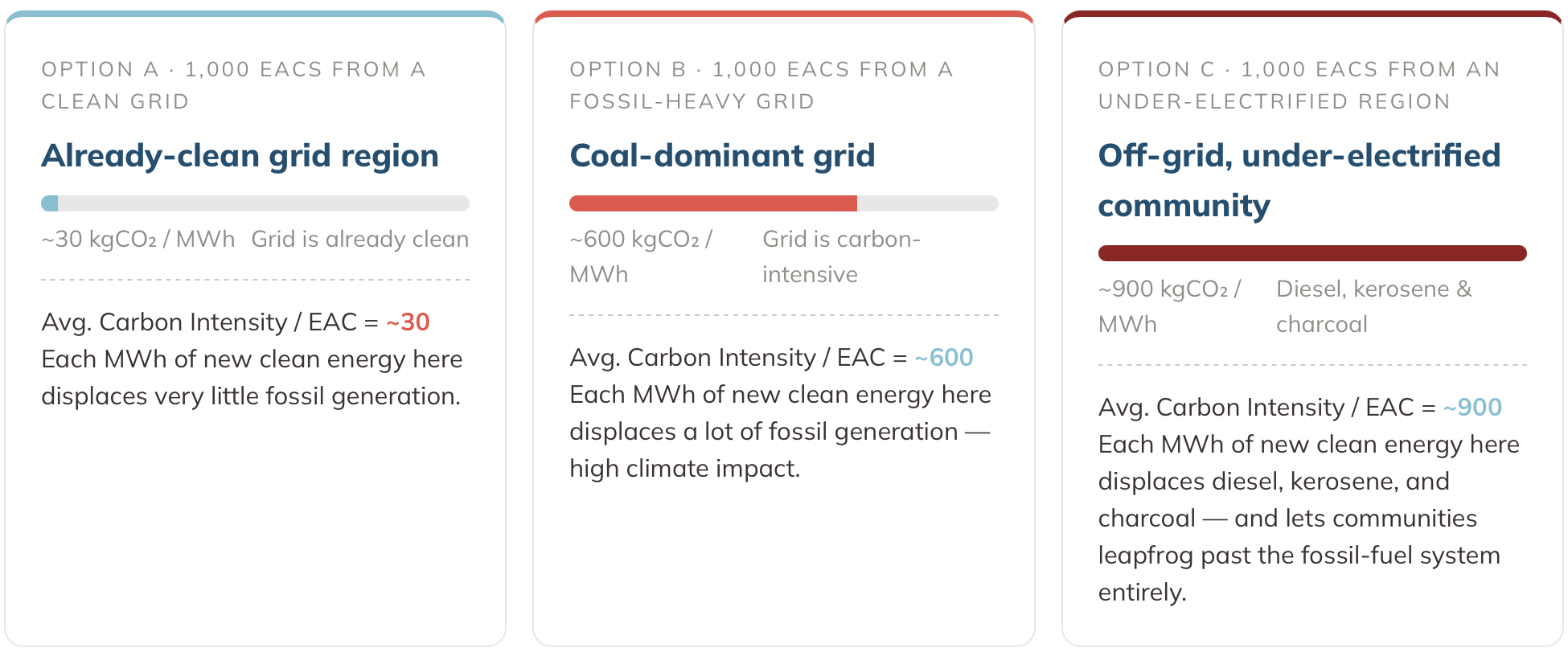
Because the EIM would help reflect the relative differences in the carbon intensity of the place where a buyer procured clean energy, this would introduce a new incentive for companies to consider and potentially prioritize the procurement of EACs that send stronger demand signals for clean energy in more carbon-intensive regions. In the case illustrated above, EIM may motivate more buyers to pursue Options B or C rather than Option A so they can report a higher (better) EIM score in their annual disclosures. Without EIM, the company’s decision to pursue Options B or C would not “count” anywhere and thus remain invisible in these disclosures.
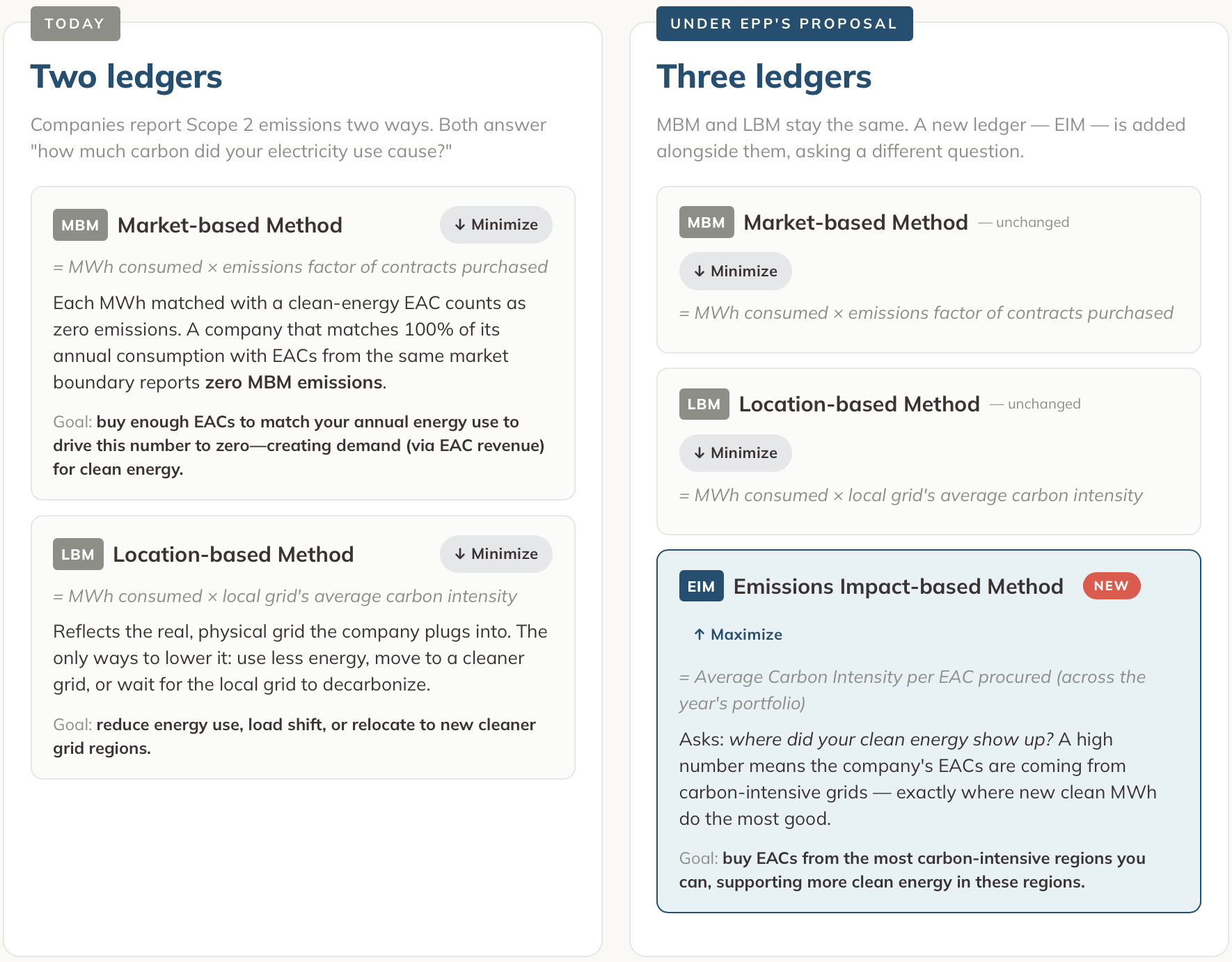
It is important to emphasize that EIM would not replace any existing methods or ledgers, but rather serve as an additional corporate reporting ledger that would sit alongside the MBM and LBM ledgers as a new third ledger. The figure below helps illustrate where EIM would be situated within Scope 2 greenhouse gas accounting.
A new calculator to understand potential EIM scores
To help make EIM more understandable for corporate buyers, advisors, and standard-setters and provide an interim solution until the GHGP potential introduces standardized calculator tools, EPP developed an online P-REC avoided emissions calculator tool and a more detailed spreadsheet calculator tool. These resources can help buyers quickly assess the potential emissions impact associated with procuring P-RECs to inform procurement decisions. The tool produces an estimate of the emissions impact based on either the MWh volume the buyer needs or their available budget using emission factors that reflect extensive research. It also allows buyers to distinguish between projects supported or not supported by the recently-approved P-REC Aggregation Facility (PAF). The calculator’s output then offers buyers a preview of the approximate EIM score and impact that their P-REC purchase may ultimately achieve.
To request access to the full spreadsheet calculator tool and/or arrange a demo of how to use the online calculator tool, please contact EPP’s Director of Market Development, Doug Miller, at dmiller@energypeacepartners.com.